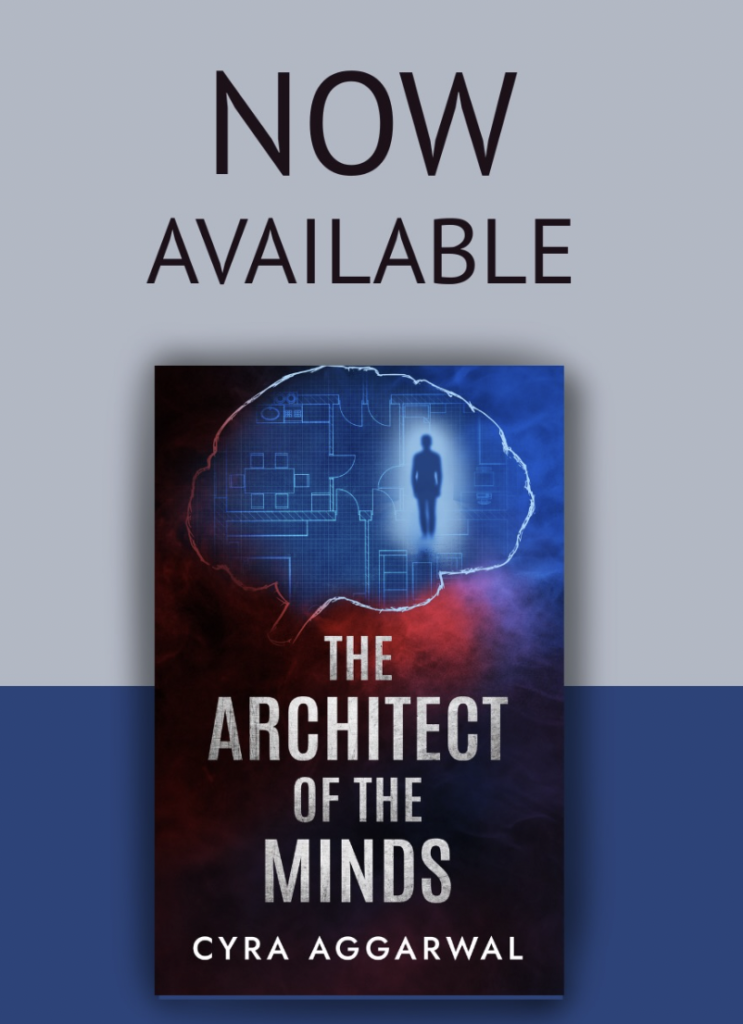
From a Blank Document to a Published Novel: The Story Behind The Architect of the Minds
For as long as I can remember, I have been drawn to stories.
Before I understood what it meant to be an author, I understood what it meant to get lost in a book. Stories became a place where I could imagine, escape, question, and see the world through perspectives different from my own. Writing eventually became my way of doing the same thing in return: creating worlds, asking questions, and putting pieces of my imagination into words.
By the time I was ten, I had started publishing my own writing online.
What began as a love for putting words on a page slowly became something much bigger. I entered writing contests. I had my work published. I started The Literary Vault, a book blog where I could share reviews, connect with authors, and explore the stories and ideas that fascinated me.
Through The Literary Spotlight, I had the opportunity to interview authors and hear about their journeys—how they created characters, developed ideas, overcame writer’s block, and ultimately turned something that existed only in their minds into something that could reach thousands of readers.
And somewhere along the way, I realized something.
I didn’t just want to write about books. I wanted to write one of my own.
Becoming an author had been a dream for years.
But in 2023, during my freshman year of high school, that dream finally began to take shape.
The Blank Document
I remember opening a blank document and beginning to write.
There was no publishing plan.
No agent.
No roadmap.
Just a teenager with an idea and a question that wouldn’t leave my mind:
What if someone could design your thoughts?
I had always been fascinated by psychology and neuroscience—the complexity of the human brain, the way memories shape us, and how much of our identity is connected to what happens inside our minds.
I wanted to turn that fascination into a story.
And so, The Architect of the Minds began.
At first, it was simply an idea.
Then it became a few pages.
Those pages became chapters.
And eventually, those chapters became a novel.
Two Years of Becoming an Author
The journey from that first blank document to a finished book was anything but simple.
There were late nights, unfinished chapters, rewritten scenes, plot holes, characters that refused to cooperate, and countless moments when I questioned whether the story would ever actually be finished.
Some days, writing felt effortless.
Other days, opening the document felt like the hardest part.
And doing all of this while navigating high school made the process even more challenging.
But I kept coming back to the story.
Because this wasn’t just another assignment or another project.
It was a dream I had been carrying for years.
Every time I rewrote a chapter, I was getting a little closer to something I had once only imagined.
Every time I wanted to give up but kept writing, I was learning what it actually meant to become an author.
And slowly, the dream stopped feeling so far away.
Welcome to the Mind
The Architect of the Minds follows a detective, a scientist, a mysterious caller, and a killer on the loose.
When a series of mysterious deaths begins to unfold, an unsettling possibility emerges: someone may be manipulating minds from the shadows.
Blending psychological suspense, mystery, and neuroscience, the novel explores questions of control, identity, memory, and the boundaries of human thought.
How much control do we really have over our own minds?
What happens when someone else tries to take that control away?
And if our memories, perceptions, and thoughts can be altered, what does that mean for who we are?
Those questions were the foundation of the story—and they are what made me want to tell it in the first place.
From Reader to Writer
There is something especially meaningful about this journey to me.
I spent years reading other people’s stories.
Then I spent years writing about them.
I interviewed authors and asked them about their creative processes. I built a community around books. I encouraged other young people to read and write.
And eventually, I got to experience the other side of the conversation.
I became the person sitting behind the story.
The person creating the characters.
The person wondering whether someone else might someday pick up my book and get lost in its pages.
That transition—from reader, to writer, to author—is something I don’t think I’ll ever take for granted.
A Dream I Can Hold
Today, The Architect of the Minds is officially published.
Paperback.
Hardcover.
Kindle.
A real book.
Sometimes I still think about that blank document from freshman year.
At the time, I couldn’t have known where it would lead.
I couldn’t have known how many pages I would write and rewrite, how much I would learn, or how much this story would become a part of my life.
I certainly couldn’t have imagined that one day I would be able to hold the finished book in my hands.
But that’s the incredible thing about dreams.
They don’t always arrive all at once.
Sometimes, they begin with something as small as a blank page.
And then you keep writing.
You keep learning.
You keep showing up.
Until one day, you look back and realize that the thing you once only dreamed about has become real.
This book started with a love of stories.
It grew from a fascination with the human mind.
It was built one page at a time.
And now, it’s finally a book I can hold in my hands.
To my family, friends, mentors, educators, authors, interview guests, readers, and everyone who believed in me throughout this journey—thank you.
And to everyone who has ever had a dream that felt a little too big, a little too distant, or a little too impossible:
Start anyway.
You never know where the first page will take you.
📖 The Architect of the Minds is now available on Amazon in paperback, hardcover, and Kindle formats.
If you read it, I would absolutely love to hear what you think. Reviews, recommendations, and shares mean the world to me.
A dream that began years ago is finally a book.
And I couldn’t be more excited to share it with you.
Learn more about this on my website.