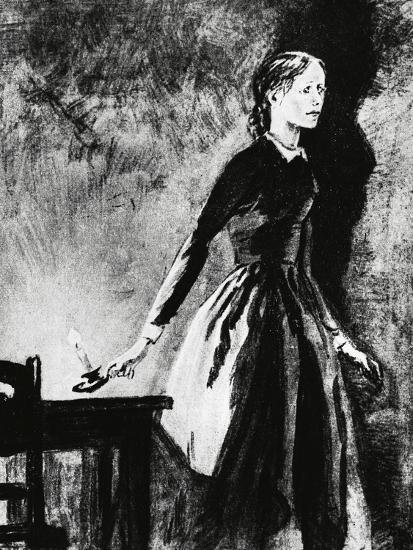
More Than a Martyr: Sonya Marmeladova and the “Catastrophic Division” in Crime and Punishment
For an AP Literature project this past school year I analyzed Sonya Marmeladova in Fyodor Dostoevsky’s Crime and Punishment. Before reading the novel, I expected Raskolnikov to be the character who carried its biggest ideas. After all, he’s the protagonist. But the more I read, the more I realized that Sonya becomes the novel’s moral center. While Raskolnikov wrestles with guilt, pride, and philosophy, Sonya offers a completely different perspective, one rooted in faith, compassion, and sacrifice.
The focus of my project was what I called “The Catastrophic Division,” the painful split between Sonya’s pure spiritual identity and the devastating reality she is forced to live. Through her, Dostoevsky asks one of the novel’s biggest questions: Can a person’s soul remain whole even when their circumstances are completely broken?
A Character Defined by Contradiction
At first glance, Sonya seems like one of the novel’s most tragic characters.
She is forced into prostitution to provide for her impoverished family, a choice made not out of selfishness or ambition, but desperation. Outwardly, society sees only her profession. Inwardly, however, Sonya remains remarkably compassionate, humble, and deeply devoted to her Christian faith.
This contradiction forms what I see as her catastrophic division. Unlike Raskolnikov, whose internal conflict is born from his own philosophical choices and overwhelming pride, Sonya’s conflict is imposed upon her by poverty and circumstances beyond her control. She doesn’t choose moral darkness; she’s pushed into it by a world that offers her no alternatives. That distinction changes everything about how we understand her suffering. Rather than becoming morally corrupted by her circumstances, she preserves her humanity in spite of them.
The Moral Paradox
One of the most fascinating aspects of Sonya’s character is the paradox she represents.
To society, she is considered a sinner. She occupies one of the lowest social positions imaginable, judged by others before they ever know her story. Yet within Dostoevsky’s moral universe, she is one of the purest characters in the entire novel.
Her body is exploited by circumstances, but her conscience remains untouched. She continues to care for her family, refuses to lose her compassion, and clings to her faith even when every part of her life seems to challenge it.
Through Sonya, Dostoevsky asks readers to reconsider what goodness actually means. Is morality determined by appearances, reputation, or social status? Or is it measured by love, sacrifice, and the choices we make when life gives us impossible circumstances? Sonya suggests the latter.
A Challenge to Raskolnikov’s Philosophy
Throughout Crime and Punishment, Raskolnikov believes extraordinary individuals can justify immoral actions if they serve a greater purpose. His theory values intellect above conscience and convinces him that some people exist beyond ordinary moral laws. Sonya dismantles that entire philosophy.
She possesses none of Raskolnikov’s intellectual arrogance. She never argues complicated theories or attempts to prove herself superior. Instead, she lives according to humility, faith, and unconditional love. Her goodness isn’t earned through status, education, or rational arguments. It comes from the way she treats others, even when life has treated her unfairly.
By placing Sonya alongside Raskolnikov, Dostoevsky creates two radically different responses to suffering. One turns inward, becoming isolated by pride. The other reaches outward through compassion. As the novel unfolds, it becomes clear which path ultimately leads toward healing.
Faith in the Midst of Despair
Faith is woven into every aspect of Sonya’s identity.
Even after enduring unimaginable hardship, she refuses to abandon her belief in God. Rather than allowing suffering to destroy her sense of purpose, she transforms it into an act of sacrifice for the people she loves.
This becomes especially significant when contrasted with many of the novel’s male characters, who wrestle with nihilism and moral relativism. While others question whether life has meaning or whether moral rules matter at all, Sonya consistently demonstrates that hope can survive even in the darkest circumstances.
Her actions speak louder than any philosophical argument. She feeds her family, forgives without hesitation, and chooses compassion over bitterness again and again. Through her example, Dostoevsky suggests that faith is not an escape from suffering but a way of enduring it without losing one’s humanity.
The Meaning Behind Her Name
Even Sonya’s name carries symbolic weight. “Sofya,” from the Greek Sophia, means wisdom. Yet the wisdom she represents is very different from the intellectual brilliance that Raskolnikov values.
Her wisdom isn’t built on logic or abstract theories. It comes from humility, empathy, forgiveness, and an unwavering trust in God. Through Sonya, Dostoevsky suggests that true wisdom isn’t measured by intelligence alone but by the ability to love others even when life offers every reason not to.
The Heart of the Novel
Although Crime and Punishment follows Raskolnikov’s journey, I would argue that Sonya becomes its emotional and moral center.
She never commits murder. She never develops elaborate philosophical theories. She doesn’t seek recognition or power. Yet she changes the course of the novel more profoundly than almost anyone else.
When Raskolnikov reaches his breaking point, it is Sonya who guides him toward confession, accountability, and the possibility of redemption. She doesn’t force him to change; she simply remains beside him with unwavering compassion until he chooses that path himself.
In many ways, Sonya transforms abstract ideas about morality into something tangible. Through her actions, Dostoevsky shows that redemption isn’t achieved through clever reasoning but through humility, love, and the willingness to confront one’s own failures.
What Sonya Reveals About Human Nature
One of the questions my project explored was what Dostoevsky ultimately believes about human nature.
Through Sonya, he suggests that people cannot be defined solely by their circumstances. Poverty, suffering, and injustice can shape a person’s life, but they don’t have to determine the condition of their soul.
Her story demonstrates that genuine goodness can survive extraordinary hardship. Even when society strips away dignity, status, and opportunity, compassion and faith remain possible. Human beings are far more complex than the labels attached to them, and true morality often appears in unexpected places.
That idea feels just as relevant today as it did when Dostoevsky published the novel.
Why Sonya Still Matters
More than 150 years later, Sonya Marmeladova continues to resonate because she challenges the way we judge others. She reminds readers that appearances rarely tell the whole story and that suffering is often invisible.
What struck me most while studying her character was that Dostoevsky never portrays her as weak. Her strength simply looks different from Raskolnikov’s. It isn’t loud or philosophical. It’s quiet, steadfast, and deeply compassionate.
In the end, Sonya stands as Dostoevsky’s answer to despair. She proves that even when life divides a person between impossible circumstances and unwavering principles, hope can endure.
Her story suggests that the strongest people aren’t always the ones who possess the most power or intelligence, but the ones who continue choosing love, faith, and kindness when doing so is hardest.
That’s what makes Sonya unforgettable, and why I think she’s the true heart of Crime and Punishment.