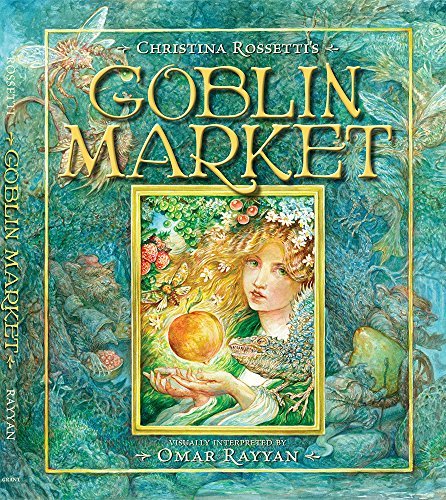
Feminism in Christina Rossetti’s Goblin Market
For an AP Literature this school year, I explored Christina Rossetti’s Goblin Market (1862), and it completely changed the way I looked at the poem. At first glance, it feels like a Victorian fairy tale about two sisters and a group of mysterious goblin merchants selling enchanted fruit. Laura gives in to temptation, suffers the consequences, and is ultimately saved by her sister, Lizzie. But beneath that familiar story is a powerful exploration of female agency, sisterhood, and the expectations placed on women during the Victorian era. Reading it through a feminist lens reveals just how ahead of its time Rossetti’s writing really was.
*** Feminist literary criticism examines how literature reflects or challenges gender roles, power, and society’s expectations of women. Looking at Goblin Market through this lens reveals a poem that questions many of the assumptions Victorian culture made about women. ***
A Little Background
Christina Rossetti grew up in a literary family closely connected to the Pre-Raphaelite Brotherhood, a movement known for its rich symbolism and artistic expression. She was deeply influenced by her Anglo-Catholic faith and spent part of her life volunteering at a refuge for women whom Victorian society labeled “fallen.” Seeing firsthand how women were judged under rigid social expectations shaped many of the ideas that appear throughout Goblin Market.
The poem was published in 1862, only fourteen years after the Seneca Falls Convention, when the organized women’s rights movement was beginning to take shape. Rossetti never described herself as a feminist, but many of the ideas woven into Goblin Market, female solidarity, independence, and resistance to exploitation, continue to resonate with feminist readers today.
Sisterhood as Strength
The heart of Goblin Market isn’t the goblins or the enchanted fruit, instead it’s the relationship between Laura and Lizzie.
Instead of waiting for a prince or another male hero to save the day, Rossetti places that responsibility in Lizzie’s hands. She willingly confronts the goblins to rescue her sister, making courage, compassion, and loyalty the driving forces of the story.
Rossetti captures that bond beautifully:
“For there is no friend like a sister / In calm or stormy weather.”
That line becomes the emotional center of the poem. In a literary tradition where women were often portrayed as passive or dependent, Lizzie demonstrates remarkable resilience and agency. Her decision to stand firm against the goblins transforms her into the poem’s true hero.
Desire and Double Standards
One of the most interesting aspects of the poem is how Rossetti portrays Laura’s temptation.
The goblin fruit is filled with vivid, almost irresistible descriptions, making Laura’s curiosity feel understandable rather than shameful. Victorian society often treated female desire as something dangerous or immoral, but Rossetti doesn’t leave Laura trapped by one mistake. Instead, she allows her to heal through love and forgiveness rather than permanent punishment.
Victorian society expected women to embody purity, obedience, and moral perfection while also portraying them as naturally fragile and easily led astray. Rossetti exposes the contradiction in those expectations through Laura’s experience. Rather than presenting her curiosity as proof that women are inherently weak, the poem suggests that these rigid standards leave women especially vulnerable to manipulation. Laura’s mistake is not treated as an unforgivable moral failure, and Rossetti chooses compassion over condemnation by allowing her to heal through the support of another woman.
That choice challenges many of the expectations surrounding women during the Victorian era. Laura is allowed to recover, grow, and continue living, a surprisingly compassionate ending for its time.
The Goblins as a Symbol
The goblin men represent more than magical creatures selling fruit.
Throughout the poem, they’re persistent, manipulative, and increasingly aggressive. They pressure Laura, ignore boundaries, and eventually try to force the fruit on Lizzie. Their behavior can be read as a metaphor for the ways women have often been manipulated, objectified, and exploited within patriarchal societies.
Rossetti’s characterization of the goblins reinforces this interpretation. They’re loud, persistent, and relentlessly persuasive, using enticing language and eventually physical force to pressure the sisters. Their animal-like features and aggressive behavior make them feel more predatory than magical, emphasizing that the real danger lies not in the fruit itself but in those who seek to manipulate others for their own gain. Read through a feminist lens, the goblins become a symbol of systems that commodify women and treat them as something to be pursued or controlled rather than respected as equals.
Symbols That Stay With You
Rossetti’s symbolism adds another layer to the poem.
The goblin fruit represents temptation, but it also reflects desires that Victorian society discouraged women from expressing openly. Laura’s longing for the fruit becomes a symbol of curiosity, independence, and the consequences society attached to female desire.
Another important symbol is Laura’s golden curl, which she trades for the fruit. During the Victorian era, a woman’s hair often symbolized beauty, innocence, and purity. By making Laura exchange part of herself before she can taste the fruit, Rossetti highlights how women were often expected to sacrifice pieces of their identity to gain freedom or independence. Yet Laura’s worth isn’t defined by what she loses, and her sister ensures that one decision doesn’t determine the rest of her life.
The Way Rossetti Tells the Story
One reason Goblin Market continues to resonate is its style. Rossetti wraps serious ideas inside a poem that almost sounds like a fairy tale. The musical rhyme, repetition, and vivid descriptions of the fruit make the story feel playful on the surface, while the darker themes underneath become more unsettling the further you read. Her sensory language makes the fruit almost impossible to resist, helping readers understand Laura’s temptation instead of simply judging it. That contrast between a familiar fairy-tale structure and complex adult themes allows Rossetti to explore difficult conversations about desire, exploitation, and gender expectations in a way that remains accessible to readers today.
The poem also functions as an allegory. While it can certainly be read as a story about temptation and redemption, it also reflects the realities women faced in Victorian society. Laura’s “fall” becomes more than an individual mistake—it represents the pressures, expectations, and dangers women had to navigate in a culture that judged them more harshly than men. Lizzie’s courage transforms the moral of the story. Rather than suggesting women need to be rescued by male authority, Rossetti argues that strength, compassion, and solidarity between women can become sources of healing and redemption.
A New Take on the Garden of Eden
The poem clearly echoes the story of Adam and Eve.
Like Eve, Laura eats forbidden fruit and experiences its consequences. But Rossetti changes what happens afterward. Instead of allowing one mistake to define Laura forever, she gives her a path to redemption through another woman.
Lizzie becomes the figure who restores hope and healing, quietly challenging the traditional narrative that women must rely on male authority for salvation. It’s a subtle but meaningful reinterpretation of one of the most familiar stories in Western literature.
More Than a Victorian Fairy Tale
What impresses me most about Goblin Market is how many different interpretations it supports. It can be read as a religious allegory, a cautionary tale, a fairy tale, or a feminist critique of Victorian society. Those readings don’t compete with one another—they build on each other. Rossetti’s ability to layer symbolism, biblical allusions, social commentary, and emotional storytelling into one poem is what has kept readers discussing it for more than 160 years. Every time someone approaches the poem from a different critical perspective, another layer of meaning emerges.
Why I Think It Still Matters
More than 160 years after it was published, Goblin Market still feels relevant because its central ideas haven’t disappeared. Questions about autonomy, social expectations, exploitation, and the importance of women supporting one another continue to shape conversations today.
What impressed me most wasn’t that Rossetti wrote an overtly political poem. She didn’t. Instead, she embedded those ideas inside a story that continues to invite new interpretations more than a century later. Looking at Goblin Market through a feminist lens made me appreciate how literature can challenge cultural norms without ever sounding like a manifesto.
“For there is no friend like a sister / In calm or stormy weather.”